Welcome to the AI-first era. In a rapidly shifting landscape, your readiness for change is your ultimate competitive differentiator. For small and growing businesses, designed to stay agile and lean, this reality represents a new sort of advantage.
A landmark October 2025 report from the Wharton School and GBK Collective reveals that multi-billion-dollar corporate giants often struggle to translate AI investments into tangible business returns. Meanwhile, companies with less than $2 billion in annual revenue report speedier financial gains and faster time to value.
Box CEO Aaron Levie posits that the reason is simple: smaller organizations don’t get bogged down in endless experimentation or bureaucratic pilot phases.
“What’s more fascinating, and revealing, is the delta between companies that are < $2B in revenue vs. those that are > $2B in revenue,” he observes. “We see much higher rates of seeing significant gains and much lower rates of still being stuck in pilot phase for the smaller company cohort.”
Key takeaways:
- Smaller organizations achieve faster AI financial returns because their lean structure allows them to quickly adopt and implement workflow changes, bypassing the organizational inertia and legacy friction that slow down large enterprises
- Simply layering disconnected AI point tools onto outdated processes fails to capture the radical transformation technology offers; true ROI comes from centralizing content and connecting it directly to automated workflows
- Underinvesting in employee enablement creates a critical bottleneck: Grounding AI in everyday work empowers teams to scale output without adding overhead or tech stack complexity
Agility delivers speedier ROI
Scale alone is no longer an automatic advantage. In fact, corporate scale can actively slow down the conversion of technology investments into measurable profit.
The Wharton study categorizes organizations by scale, identifying enterprises with over $2 billion in annual revenue as Tier 1. Weighed down by siloed systems and complexity, these organizations are significantly more likely to report that it’s “too early” to calculate AI returns, despite substantial capital expenditures. In contrast, mid-sized and smaller firms are realizing ROI much faster.
AI magnifies this classic difference because it changes the nature of work vs. just is another technology that you implement and move on from.
This agility advantage is reflected in recent research from Box’s State of AI Report: 45% of the smallest businesses (those with 100–300 employees) report realizing measurable business impact within 6 to 12 months of deploying AI. Nearly one in four (23%) report seeing significant improvements with ROI exceeding 25%, indicating that meaningful gains don’t require massive corporate budgets.
For growing teams, the process of adopting AI has moved beyond novelty applications and collections of disconnected point tools. Now, they’re using AI for practical leverage: turning business documents into usable data, eliminating repetitive manual work, and giving lean teams the operational power of a much larger enterprise.
Reinventing starts with reengineering workflows
“Big or small, the companies that get ahead with AI will be those that start to redefine their workflows in an AI-first way,” Levie says. Capturing the full promise of AI requires moving beyond ad-hoc experimentation toward true workflow transformation.
Wharton predicts that organizations establishing structured, measurable ROI will achieve sustainable performance at scale. For large enterprises, this demands overcoming organizational gridlock to overhaul rigid systems. For smaller, fast-moving businesses, the directive is clear: maintain agility and build on a unified foundation.
“The amount of output you get from AI agents will be directly correlated to how much you change (or reset) your workflow,” Levie says. “It’s a continuum from [businesses] designing a process from scratch at one end to those not willing to change a thing at the other.”
Big or small, the companies that get ahead with AI will be those that start to redefine their workflows in an AI-first way.
Small businesses are already looking toward this autonomous future. According to the Box State of AI Report, 41% of small businesses believe that AI agents will become central to automating enterprise workflows across their organizations. Reaching higher stages of AI maturity where AI actively supports and orchestrates end-to-end workflows requires modernizing how work gets done from the ground up. Smaller businesses can adapt their processes more seamlessly, giving them an edge in operationalizing AI across core functions like contract reviews, onboarding, and knowledge management.
Your people set the pace
Unlocking the power of AI across your organization requires closing the gap between strategic vision and day-to-day execution.
Wharton reports that 43% of leaders warn of skill atrophy without deliberate role design, coaching, and hands-on practice, even as 89% acknowledge that generative tools augment work. Frontline and mid-level managers often report lower initial optimism than senior executives when tools are rolled out without clear business context.
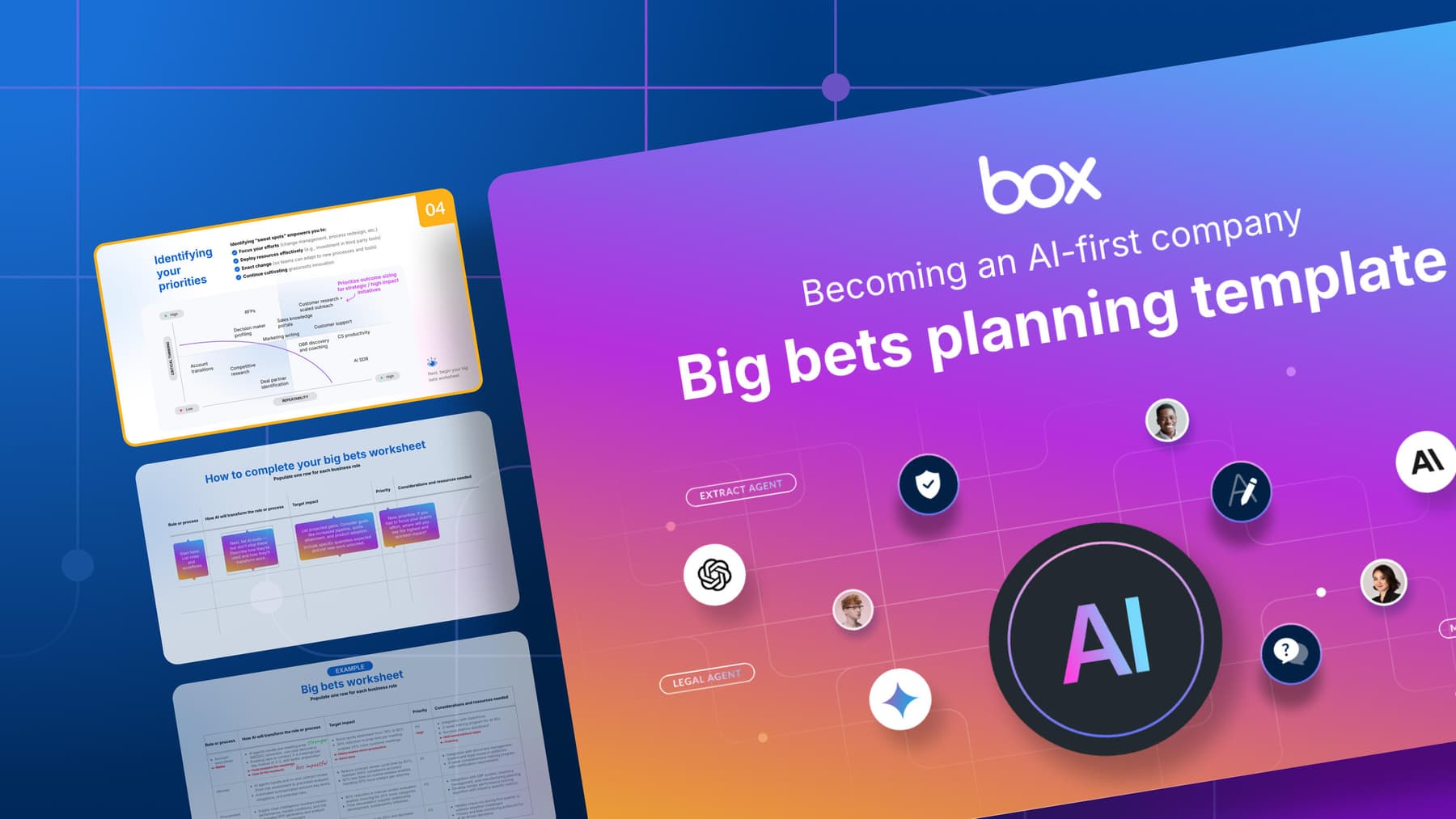
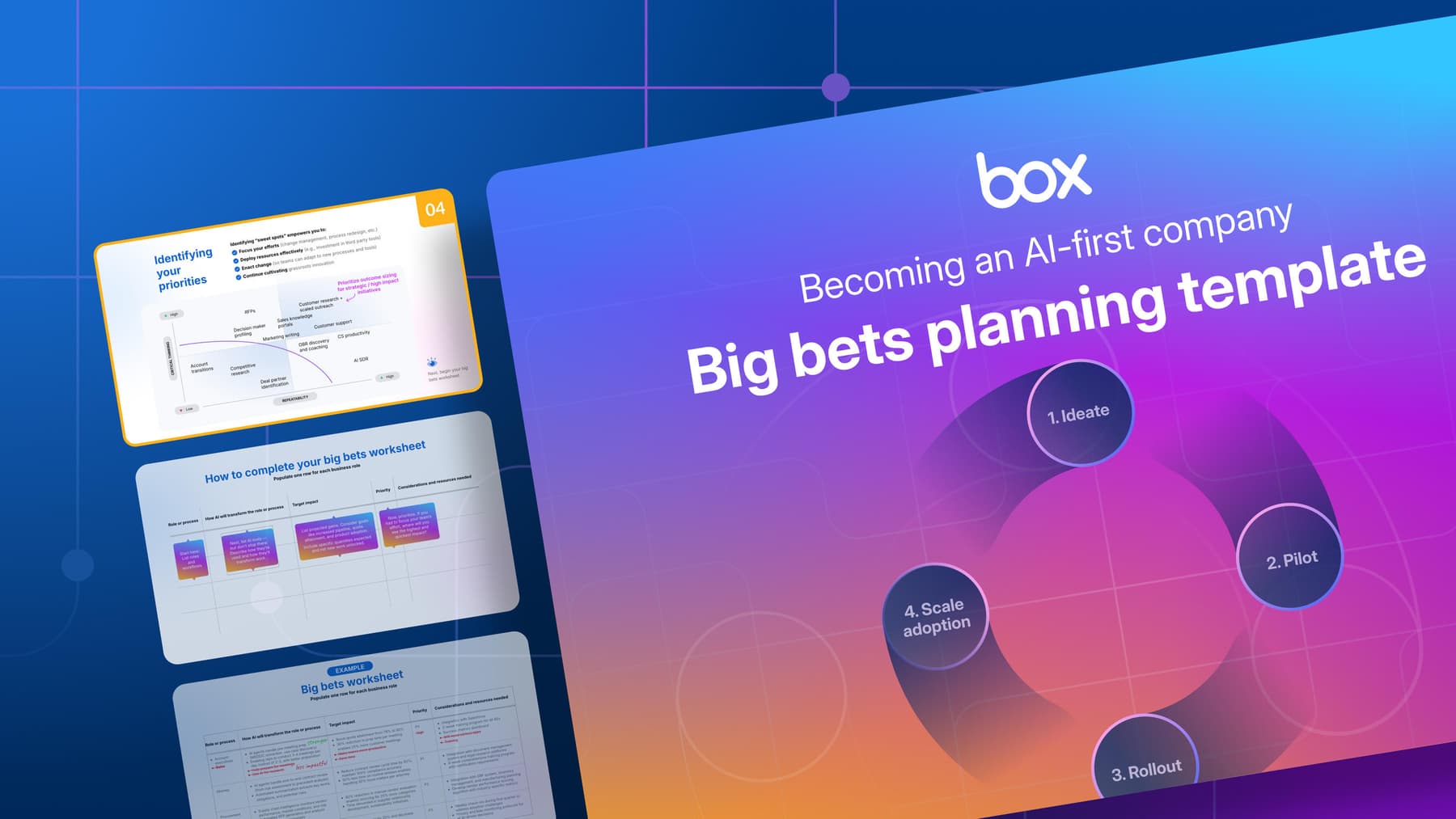
Bridging this gap starts with a clear, proven enablement strategy. Box follows a structured approach that empowers employees to learn, test, and apply AI directly where their work and content already live, followed by focused strategic bets to avoid getting trapped in ideation.
“While there might have been this belief that you can just spin up your own agent and get going,” says Olivia Nottebohm, Box Chief Operating Officer. “Yes, that’s true for some smaller tasks. But if you’re really trying to transform your business, you probably want to be a little more intentional about it.”
Practical steps to secure your AI strategy
If AI ROI is a function of agility and focus rather than sheer budget size, capturing lasting gains hinges on a consolidated, secure approach. To accelerate your organization's journey, consider these research-backed principles:
- Consolidate rather than accumulate: Avoid tool sprawl. Bringing your content, workflows, and AI together in one secure platform ensures AI agents are grounded in accurate business context without creating shadow IT or security blind spots.
- Automate high-impact, repeatable workflows: Focus deployment on frequent tasks that benefit from intelligent reasoning, such as extracting data from incoming invoices, summarizing complex proposals, routing contracts for approval, and streamlining client onboarding.
- Turn unstructured documents into usable data: Unlock institutional knowledge trapped across files, project archives, and contracts. (Note that 44% of small businesses consider automatically extracting structured data from unstructured files as very important to powering downstream automation and operational efficiency.)1
- Prioritize built-in governance and data protection: Ensure your AI adoption is supported by robust access controls, granular permissions, and compliance guardrails (including standards like HIPAA and FINRA) so your business can move fast without cutting corners on trust and compliance.
The AI race won’t be won by the biggest budgets, but by the fastest learners, and small businesses are already leading the way. For inspiration, read about Box’s own AI-first transformation.