MIMIT Health uses Box as the secure foundation for all its unstructured clinical data, with Box AI cutting complex research tasks from hours to minutes. Box Shield ensures the company supports HIPAA compliance, and Box Shuttle saved teams $80,000 on a single EHR migration.
Healthcare organizations don’t lack data, but they lack a secure way to make the right data usable at the moment of care. MRI studies, surgical reports, insurance documents, scanned records, and clinical notes often live across disconnected systems and file formats, which makes AI hard to trust when clinicians need answers quickly — especially if you take into consideration the legal and ethical mandate to protect PHI.
MIMIT Health, a US-based physician-led healthcare organization, solved that problem by using Box as the governed content layer for its clinical workflows.
In fact, MIMIT Health has built an advanced AI-powered clinical workflow around its own content. MIMIT Health’s story offers a model for healthcare organizations everywhere.
Key takeaways:
- MIMIT Health built a strong AI foundation by centralizing unstructured clinical content in Box
- Box AI dramatically speeds up clinical and operational workflows like reviewing MRI findings, preparing for surgeries, and handling insurance authorization
- Box delivered measurable business and compliance value: MIMIT Health used Box Shuttle to avoid an $80,000 EHR migration cost, while Box Shield helped support HIPAA compliance across sensitive healthcare workflows
Great data, if you can figure out how to use it
Dr. Paramjit “Romi” Chopra has been a Box customer since 2013. As a physician, entrepreneur, and self-described digital transformation enthusiast, he’s spent decades trying to solve a problem that plagues healthcare organizations of every size: Critical patient information lives in too many places, in too many formats, and is nearly impossible to access quickly when it matters most.
“Most AI platforms are failing,” Dr. Chopra says. “Why? Because they don’t have a data foundation. AI doesn't work if you don't have the bedrock of good data — structured, unstructured, whatever it is.”
This situation is even more acute when you factor in that data comes in both structured and unstructured formats. MIMIT Health manages structured clinical data (schedules, billing, patient records) that’s easy to sort into fields. But enormous volumes of unstructured data include surgical reports, MRI studies, insurance documentation, scanned records, and more. A lot of valuable information lives inside these unstructured files, also known as content.
When MIMIT Health switched electronic health record (EHR) systems, its previous vendor handed over a 10-terabyte drive of files in mixed formats. The vendor wanted $80,000 to migrate the data to Box. Dr. Chopra declined, and quickly used Box Shuttle to move everything himself, at no additional cost.
That migration, and the partnership with Box, became the foundation for something much bigger.
An integrated content layer that touches everything
MIMIT Health now uses Box, which is integrated tightly with Salesforce, Slack, Claude, and Snowflake, as the central repository for all of its unstructured data.
The architecture is straightforward: Structured data lives in Salesforce; everything else lives in Box and is protected by Box Shield to support HIPAA compliance.
The architecture is straightforward: Structured data lives in Salesforce; everything else lives in Box and is protected by Box Shield to support HIPAA compliance. Together, that foundation enables a Retrieval-Augmented Generation (RAG) approach, where relevant information is pulled from Box and paired with structured data to ground the model’s response. Integrations with Salesforce and other key tools make it easy to use both unstructured and structured data across all kinds of workflows.
“To me,” says Dr. Chopra, “LLMs are human knowledge combined with reasoning. To make them useful in medicine, you have to ground them in your own content — that’s the RAG.”
How to be a medical professional in the age of AI
To understand just how flexible and agile this new content layer makes things, Dr. Chopra describes a recent scenario. (Note: All case details in this post are illustrative and de-identified.)
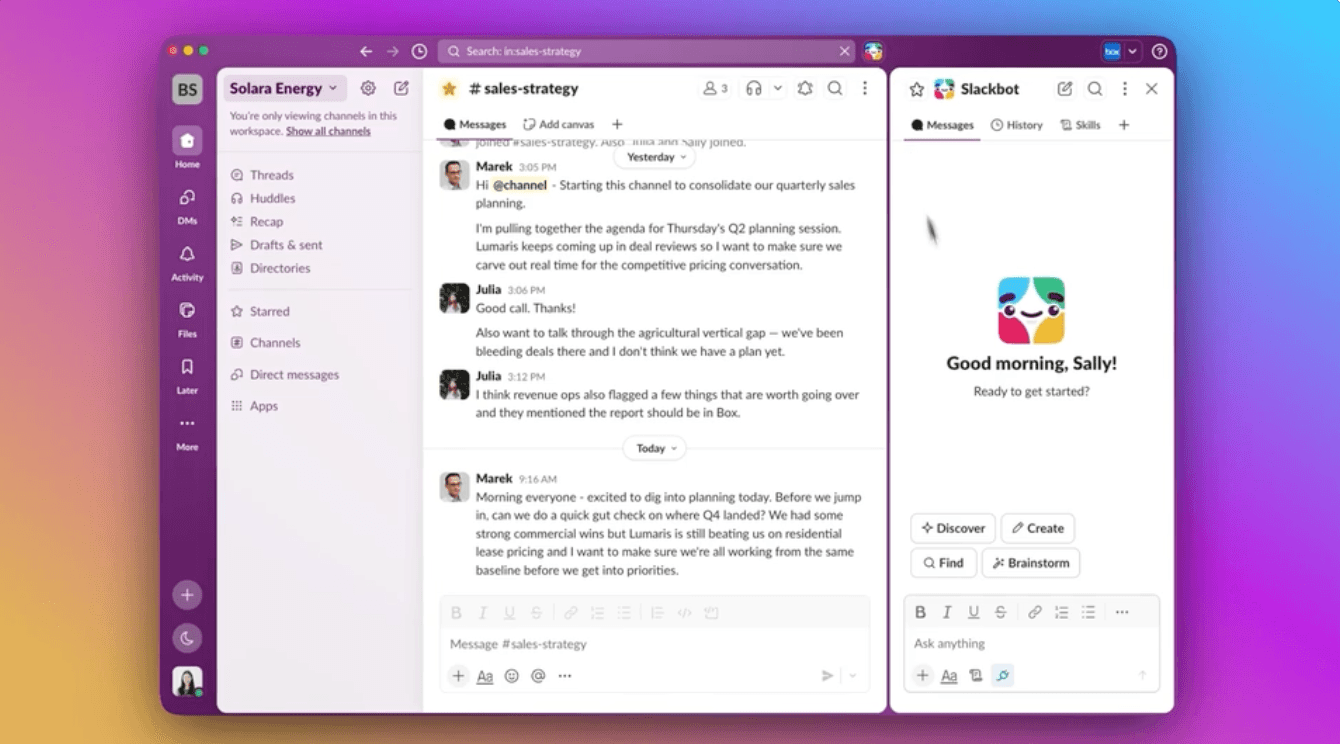
He was in an airport lounge when a colleague called about a patient with a complex uterine fibroid tumor. Using a custom Slackbot, he pulled the patient’s MRI study and health history directly from Box and asked Box AI (in Pro mode) to summarize the document and identify key findings.
Box AI then matched the findings to the patient’s criteria, helping Dr. Chopra make a decision informed by national and international clinical guidelines. In seconds, Box AI generated a summary for clinician review before it was added to the patient’s chart, all within the five minutes Dr. Chopra was on the call.
He says, “This would have been impossible [in the past]. It was like a research exercise, and would have taken probably three to four hours,” and adds, “I call this medicine at the speed of life.”
In another example, after a recent international trip, as Dr. Chopra took a car home from the airport, he knew he needed to prep for seven surgeries the next day. “These are complex patients,” he says, “people who might lose a leg if I don’t do it right.”
So he opened Slack, asked MIMIT’s custom Slackbot to check his schedule and pull the patient list, and received a full summary of each patient’s history, documentation, and care plan — all sourced from Box.
Expedited answers from anywhere
When MIMIT Health onboards a new patient, a Box workflow automatically creates a folder for that patient with an associated Box file request link. Healthcare practitioners can then upload documentation to that Box folder — things like massive PDF files with surgical reports, imaging studies, and clinical notes. The team can then ask Box AI to summarize all of that information and ask specific questions about it.
Dr. Chopra describes one situation where a colleague asked him for help with two different patients — one in Delhi, the other in Mumbai. After quickly uploading the associated patient files to Box, Dr. Chopra used Box AI to help him sort through all the information.
“Otherwise,” Dr. Chopra says, “they would have FedExed me 200 pages. That’s a cognitive overload I would have never managed. We have baked Box into this workflow.”
Because of this, within an hour, talking on Zoom, the team was able to land on diagnoses for the patients and even identify relevant clinical trials.
From 5 hours to 5 minutes for insurance authorization
What makes all of this possible is that MIMIT Health has connected Box to a broader agentic architecture they call the Intelligent Healthcare Operating System (IHOS). The stack is Box AI + Salesforce Agentforce + Slackbot + Claude, all interoperating via MCP.
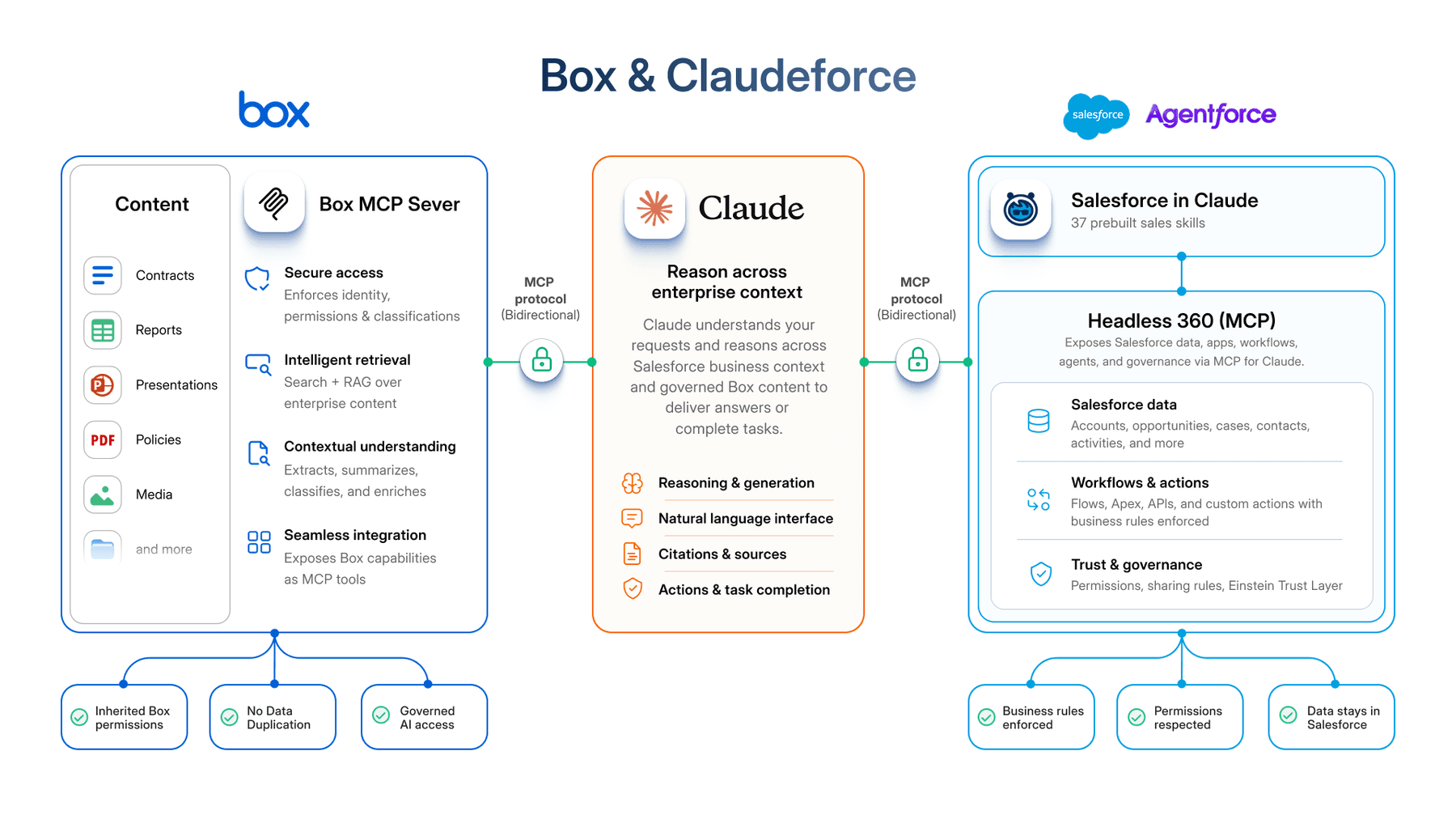
IHOS functions as a headless EMR (electronic medical record) — clinicians and patients never touch a traditional EHR (electronic health record) interface. Instead, they interact through Slack, custom portals, and conversational agents, while Box provides the governed content layer and Salesforce holds structured data.
Among other things, this system is used to conduct insurance authorization workflows. It uses Slack as the front door, with AI agents that can invoke Box to retrieve documents, summarize content, check insurance authorization criteria against clinical guidelines, and route outputs to the right people, all in a single workflow.
AI-powered workflows have reduced insurance prior authorization from five hours to five minutes.
Importantly, before the documentation is submitted to the insurance industry, a human receives it to make the final decision. These AI-powered workflows have reduced insurance prior authorization from five hours to five minutes.
IHOS is also the system behind a new patient onboarding workflow. MIMIT Health has been piloting the ability for new patients to enter a portal directly from the website that allows them to upload their driver’s licence, insurance card, and other important information. This workflow is built on Box via the Box for Salesforce integration, Box MCP server, and Slackbot — but to the aspiring patient, it’s all very simple.
AI needs a governed content layer
These examples paint a picture of AI capability in the daily life of a busy physician and healthcare organization, but none of these things would be possible without a secure, centralized content layer. When it comes to content and medicine, the security layer is non-negotiable.
Box Shield helps MIMIT Health protect sensitive data and support HIPAA compliance, whether a clinician is accessing records from a clinic, a lounge, or a moving vehicle in New Delhi. Dr. Chopra says, “Going down to the actual file level for credentials is huge — and to do this at the mobile level is also huge.”
MIMIT Health is not a large academic medical center with a dedicated IT department. It’s a physician-led organization building advanced AI workflows by being deliberate about where clinical content lives, how it’s protected, and how it connects to the tools clinicians already use.
Many of the ways MIMIT Health is using AI improve patient experience and provider efficiency, but beyond this, there’s an expected positive impact on patient outcome. Providers can make decisions faster and perhaps more confidently when they have quick access to all their information in the moment.