AI initiatives can veer off course before building even begins.
A team wants an assistant that answers policy questions, but policies are outdated. A department wants to automate contract review, but no one’s defined what “review” needs to include. Great ideas are a dime a dozen, but ideas won’t get far without the right content foundation.
Before you build an agent or introduce a new AI-powered workflow, you need to understand the challenge you’re solving, assess the content behind it, and define what success looks like. These are foundational skills in the Box Certified AI Strategist curriculum, and they can help you turn a promising idea into a use case your organization can evaluate, design, and test.

Here’s a practical framework to move from “we should use AI” to “we’ve established a well-defined use case.”
Start with the problem, not the technology
The strongest AI use cases begin with a specific business problem, not with a feature or tool.
Instead of starting with “we need an AI agent,” ask:
- Where are people spending too much time searching for information?
- Which processes involve repetitive document review?
- What questions or requests come up again and again?
- Where do people manually move information between documents or systems?
- Which tasks produce inconsistent results or frequent rework?
Talk to the people who perform the work. Ask them to describe the last time they completed the process, including where they searched for information, which files they used, and where they needed help. Whenever possible, observe the workflow directly. A process may look simple in a procedure document — when in reality it actually includes several informal steps, workarounds, or handoffs.
You may discover outdated content, unclear ownership, inconsistent processes, or information stored across too many locations. Defining the problem clearly helps you determine how to implement the right AI solution — and what needs to be addressed before you build.
Identify workflows ideally suited for AI
Promising use cases usually share a few characteristics.
1. The work happens repeatedly
A task that occurs frequently gives your team more opportunities to benefit from an improvement. Repeated HR questions, routine document reviews, and recurring content requests are all worth exploring.A task that happens once a year for one person may still be important, but it is less likely to be the best place to begin.
2. Content powers the process
Box AI works with the information contained in your organization’s files. Strong use cases often require people to find, review, summarize, compare, extract, or create information from content.
Examples might include:
- Answering questions using approved policies
- Extracting key fields from contracts or forms
- Comparing versions of a document
- Summarizing research or meeting materials
- Drafting content using existing reference files
The more clearly you can identify the content behind a process, the easier it becomes to evaluate the use case.
3. The outcome is clear
You should be able to describe and measure results the solution needs to produce.
“Help employees work faster” is difficult to evaluate. “Answer common benefits questions using the current HR policies” is more specific. It identifies the users, the content, and the expected result.A clear outcome also helps you determine what to measure and where human judgment belongs.
Define the role of human judgment
Some work is better suited for humans, because it depends heavily on subjective, emotional, relational, or high-stakes judgment.
That doesn’t mean AI has no role. It means you need to define the boundary between AI assistance and human decision-making.
For example, an AI solution might help an HR team locate the relevant benefits policy and prepare an initial answer. A member of the HR team should handle questions that require interpretation, involve an unusual situation, or could significantly affect an employee.
As you define the use case, ask:
- What can AI prepare or recommend?
- What must a person approve?
- What should happen when the answer is uncertain?
- Which situations should be escalated?
- What should the solution never do?
These decisions are part of the usecase design, not details to address after launch.
Audit the content behind the use case
Once you identify a promising problem, review the content the solution would use.
The Box Certified AI Strategist curriculum organizes this review around four dimensions:
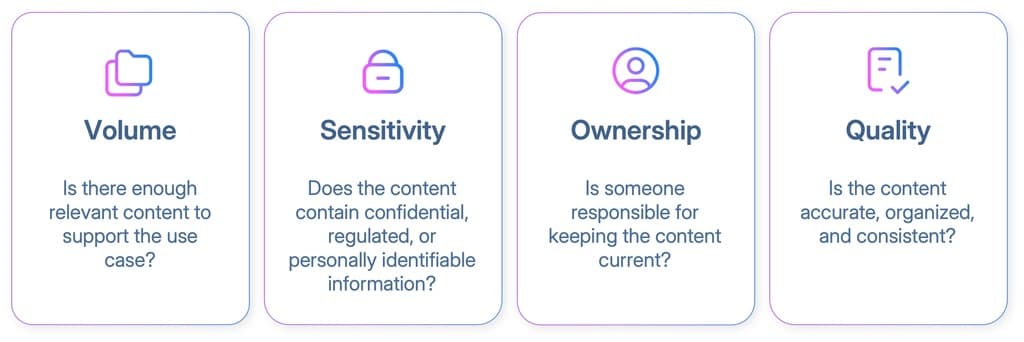
Suppose you want to create an AI-assisted experience for employee policy questions. Before moving forward, identify the specific employee handbooks, benefits guides, leave policies, and frequently asked questions that would support it. Then look for common content issues:
- Outdated or duplicate files
- Conflicting versions of the same policy
- Files owned by former employees
- Missing review dates
- Inconsistent naming or organization
- Incorrect permissions
- Documents containing information that should not be broadly available
AI can make content easier to find, but it does not make unreliable content trustworthy. Content quality and governance are prerequisites for a useful AI solution. If your audit reveals significant issues, content cleanup may be the most important first step.
Match the problem to a design pattern
After defining the problem and reviewing the content, think about the shape of the solution. The Box Certified AI Strategist curriculum introduces four common design patterns.
Knowledge Q&A
Use this pattern when people need answers from an approved set of content.
Examples include HR policy questions, IT documentation, product information, or onboarding materials.
Document review and extraction
Use this pattern when people repeatedly review files to identify, compare, or capture specific information.
Examples include extracting terms from contracts, collecting fields from invoices, or reviewing forms for missing information.
Content generation and drafting
Use this pattern when people create new material using existing content as a reference.
Examples include drafting RFP responses, preparing summaries, or creating follow-up communications based on approved documents.
Multi-step routing
Use this pattern when the process includes several steps, decisions, or handoffs.
Examples include triaging requests, routing documents for review, or directing exceptions to the appropriate person.
A use case may eventually combine more than one pattern. For an initial pilot, however, it is usually helpful to define one primary job the solution needs to perform.
Define success before you build
A strong use case includes a way to evaluate whether the solution helped.
Start by documenting what happens today. Depending on the workflow, that baseline might include:
- Time required to complete the task
- Number of manual steps or handoffs
- Volume of repeated questions
- Frequency of errors or rework
- User satisfaction with the current process
- Consistency of the final output
Then choose a small set of measures connected to the original problem.
For example, if employees struggle to find HR information, you might evaluate whether they can locate a useful answer more easily and whether the HR team receives fewer repeated questions. If a team reviews contracts manually, you might compare review time and the consistency of extracted information.
Avoid defining success only as “people used the tool.” Adoption matters, but it does not tell you whether the solution improved the workflow.
AI in action: HR policy example
Imagine an HR team receives the same benefits questions each week.
The initial idea might be: “Let’s build an AI assistant for HR.” Using the framework above, the team can make that idea more specific:
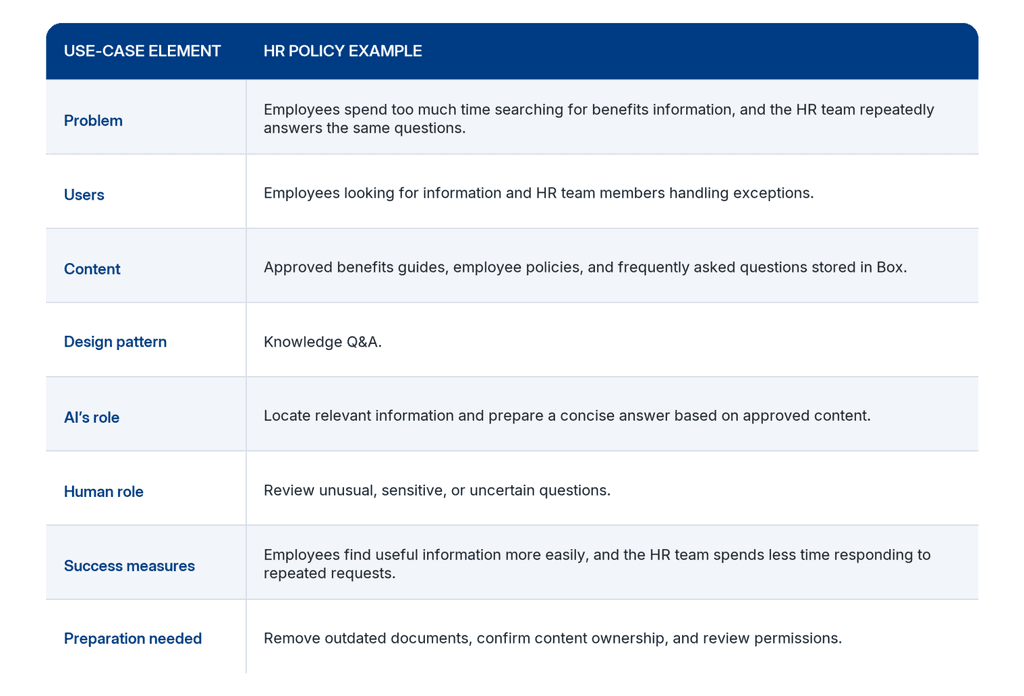
This is much more actionable than “Build an HR agent.” It gives the team a problem to solve, content to evaluate, boundaries to follow, and outcomes to measure.
In practice, an employee could ask a benefits question and receive a relevant answer based on the current policy — without searching across folders or waiting for a routine response. The HR team could spend less time answering repeated questions while remaining involved when a request is sensitive, unusual, or unclear.
The framework makes the idea specific enough to evaluate and test.
Want to build your skills?
If you want to apply this framework in greater depth, the Box Certified AI Strategist certification covers how to evaluate use cases, design AI solutions, plan adoption, measure value, and establish responsible governance. It is designed for Box admins, power users, workflow owners, and team leads who want to move from using Box AI to leading AI adoption. After completing the curriculum and passing the exam, you’ll earn a shareable digital certificate.
Explore the Box Certified AI Strategist certification and continue learning at Box University.