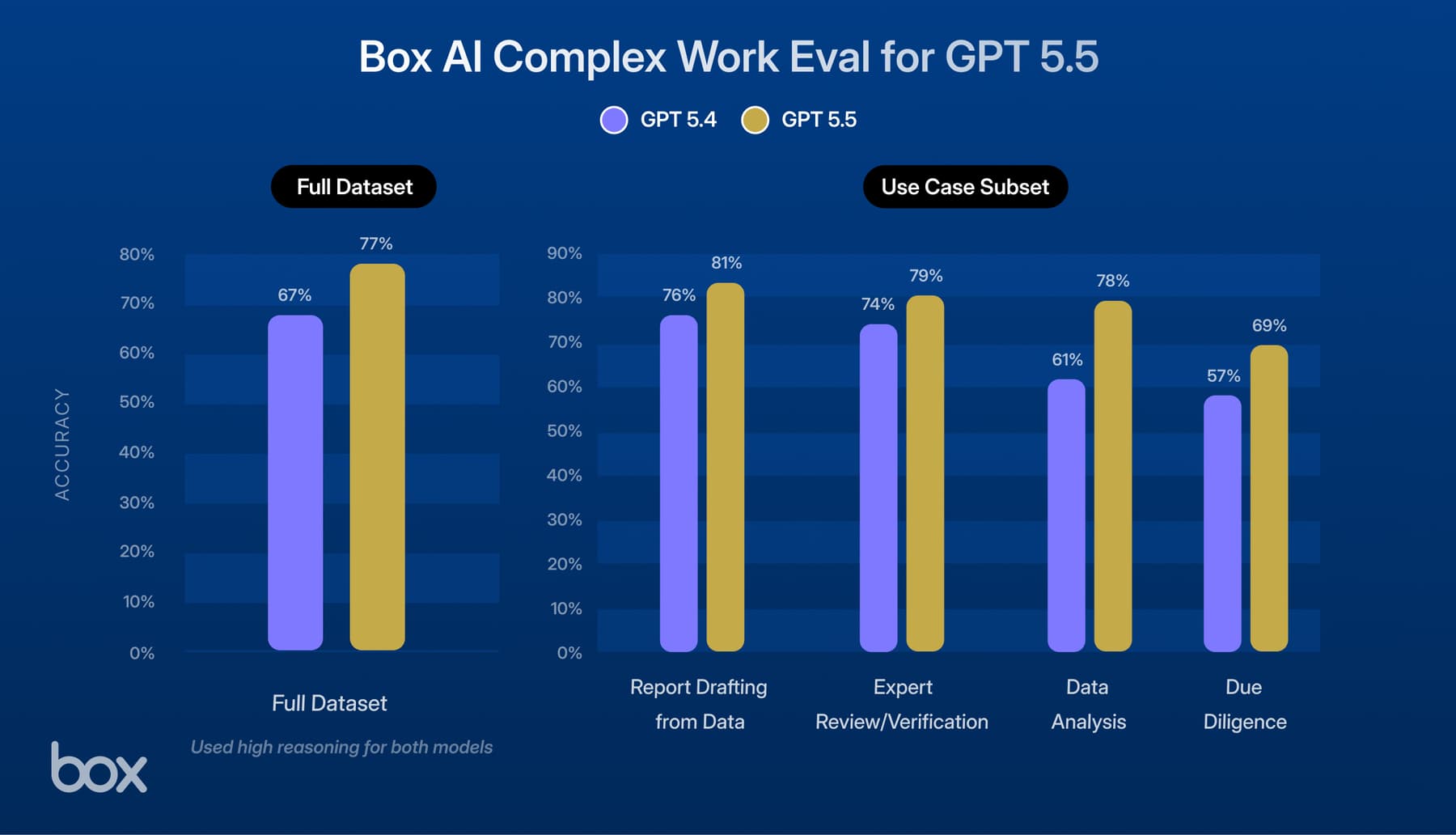
At Box, we evaluated the new GPT-5.6 family — Sol, Terra, and Luna — on the Box Complex Work Eval, our benchmark of realistic, document-grounded tasks across twelve industries. The tasks mirror the analytical work knowledge workers actually do: reading source documents, reconciling numbers, running due diligence, and reviewing expert output for errors. Here's what we found.
Overall, GPT-5.6 Sol edges past the prior-generation GPT-5.5 by about 1% on the benchmark — but the headline number understates the story. Sol's gains concentrate in the hardest, most consequential work, and especially in quantitative data analysis, where the improvement is far larger.
Stronger across the industries that run on numbers

Sol's advantage is clearest in the most demanding, number-driven industries, where a wrong figure carries real cost:
- Financial Services (76% vs 71%). On a multi-year financial projection, Sol carried revenue, EBIT, and interest expense through to the correct figures across years — where GPT-5.5 drifted on the downstream numbers that depend on getting the early ones right.
- Public Sector (74% vs 63%). On a task that recomputes every student's grade under a revised weighting scheme to within a tenth of a percent, Sol held the arithmetic across dozens of records; GPT-5.5 lost accuracy partway through.
- Retail (72% vs 66%). On a product-performance analysis, Sol computed each item's contribution against the correct subcategory denominator and reached the right ranking — sidestepping the easy mistake of dividing by the category total.
- Energy (61% vs 54%). On operational reporting from raw energy data, Sol turned the underlying figures into a coherent, correct report where GPT-5.5 was less consistent.
- Life Sciences (60% vs 51%). On diagnostic test-record analysis — computing seasonal positivity ratios and reconciling test counts — Sol grounded its answer in the right figures where GPT-5.5 miscounted.
- Healthcare (58% vs 46%). On a clinical case review, Sol correctly identified the diagnosis and intervention and avoided a penalized misstep in the treatment sequence — the kind of judgment where a wrong call is the whole risk.
Where the gains are largest: data analysis

Zooming in on data analysis — taking raw, imperfect source data and producing a defensible number — is where Sol separates most. Across all data-analysis tasks, Sol scores 64% to GPT-5.5's 57%, a far wider margin than the overall benchmark shows.
And within data analysis, the same industries pull even further ahead. On retail data-analysis tasks Sol reaches 80% versus GPT-5.5's 63%; in Life Sciences, 51% versus 27%; in Healthcare, 62% versus 50%; and in Financial Services, 78% versus 75%. These are tasks where a single wrong assumption cascades through an entire model — an adjustment double-counted, a rate applied to the wrong base, a total that doesn't tie out. On the analytical work that drives real decisions, Sol is consistently the more reliable engine, and by the widest margins on the hardest problems.
Terra and Luna: near-flagship quality, meaningfully faster
Sol is the flagship, but the family's efficient tiers — Terra and Luna — are the pragmatic choice for work at scale. They trail Sol only slightly on quality while running materially faster, and the ordering is consistent all the way down: on average latency, Terra runs about 16% faster than Sol, and Luna runs about 3% faster than Terra and 19% faster than Sol.
That speed compounds on exactly the high-volume, structured work that fills most enterprise workflows — routine reporting, first-pass review, document triage. On a retail inventory-and-margin analysis, Luna returned a complete, defensible answer in about half the time the flagship took. When you're running thousands of these a day, finishing each one faster — without giving up much accuracy — is what changes the economics. For throughput-bound workflows, Terra and Luna deliver near-flagship quality at a fraction of the time.
Get started
GPT-5.6 brings a sharper analytical engine to enterprise work — Sol for the high-stakes quantitative analysis where accuracy is everything, and Terra and Luna for the high-volume work where speed matters. The models are coming soon to Box AI — reach out to your Box account team or try them in Box AI Studio.
Evaluated on the Box Complex Work Eval, a benchmark of realistic, document-grounded enterprise tasks across twelve industries and multiple modes of analytical work. Scores reflect performance against a weighted rubric of correctness criteria per task.