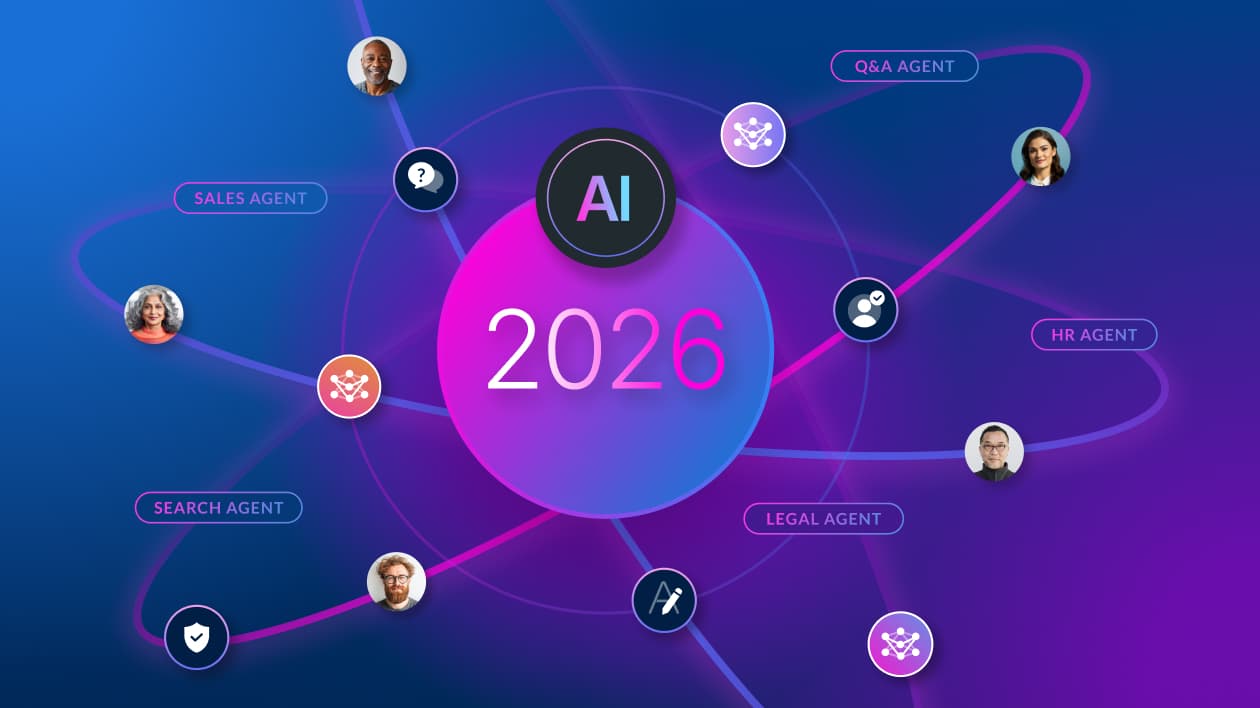
When we talk about AI and the future of work, someone usually asks about “the human in the loop”. Here’s my answer to that: The trajectory AI is on will ultimately automate complete workflows, which will decouple revenue growth from head count growth. That means hiring will be different, because jobs and the very nature of how things get done will be different. That’s not job replacement or outsourcing, that’s evolution.
Of course, there are jobs that AI will render irrelevant. Think about switchboard operators, who once manually connected telephone calls by plugging cables into jacks. Technology didn’t just eliminate that job, it transformed how we communicate, which meant new and entirely different jobs appeared. AI is going to create the same sort of evolutionary change in the job market: not necessarily fewer jobs, just different ones.
Redefining work, not the relevance of humans
Doug McMillan, CEO of Walmart, recently told the Wall Street Journal: “It’s very clear that AI is going to change literally every job. Maybe there’s a job in the world that AI won’t change, but I haven’t thought of it.”
While McMillan’s stated goal is to maintain Walmart’s 2.1 million headcount over the next three years, he acknowledges the mix of those jobs will change dramatically. That framing matches what we’re hearing everywhere: The real challenge is not the relevance of humans; it’s the design of work itself.
A recent Gartner survey projects that by 2030:
- 0% of work will be done by humans without AI in the mix
- 75% of work will involve AI on some level
- 25% of work will be conducted entirely by AI
Gartner calls on companies to master the balance of AI readiness with “human readiness to sustain value from AI.” That means equipping the workforce to succeed with AI. If we design work around repeatable tasks, machines will always win. If we design work around judgment, creativity, relationships, and purpose, humans become even more essential.
Which brings us to what we call the expertise paradox: AI amplifies skills gaps rather than closing them. Organizations with deep human domain expertise get exponentially more value from AI than those attempting to use AI to bypass fundamental competence. In other words, your AI efforts are only as good as the humans wielding these tools.
In the age of AI, how to show up as a human leader
If Gartner is right that by 2030, virtually all work will involve AI in some way, then our own roles as leaders will transform just as dramatically. We’re shifting from “managing people and technology” to designing the relationship between humans and intelligent systems. As a CIO myself, here are a few reflections on how we can evolve and show up differently in 2026.
1. Narrate the change in plain language
I’ve learned that in times of transformation, clarity beats complexity every time.Your teams don’t need to know how transformer models work. They need to know how AI will make their Monday mornings different.
That means:
- Explaining in simple, concrete terms how AI will change work in your organization — Instead of hiding behind technical jargon and corporate speak, use real examples
- Being explicit about what you intend to automate, where you will use AI to enhance people, and what work you will deliberately keep human only
- Admitting what you don’t yet know, and sharing how you plan to learn and adjust
If we don’t narrate the change, others will fill the silence with fear, rumors, or hype.
Your teams don’t need to know how transformer models work. They need to know how AI will make their Monday mornings different.
2. Make your own learning visible
Our teams are being asked to learn new tools, new processes, and new ways of thinking. The question they’re silently asking is: “Are our leaders learning too?”
As leaders in 2026, we need to:
- Talk openly about the AI tools we’re experimenting with — what worked, what didn’t, and what surprised us
- Block visible time in our calendars for learning, and treat AI literacy as seriously as financial or regulatory literacy
- Ask questions in public forums and town halls, signaling that curiosity is not a weakness but an expectation
By learning in public, we give our teams permission to experiment, fail, and grow. At Box, we regularly share AI learnings in our weekly Friday meetings, where leaders and teams are invited to share both wins and mishaps.
3. Recommit to deeply human leadership moments
The more we automate, the more precious human moments become. In 2026, I believe we will be judged less on how many AI pilots we launch, and more on how we show up when it really matters:
- Owning accountability when AI-enabled processes go wrong, rather than disappearing behind “the system” or “the algorithm”
- Recognizing and rewarding ethical choices, collaboration, and long-term thinking, not only efficiency gains
- Making time to be physically present in the field — in factories, branches, warehouses, hospitals and schools — to witness and learn how AI is really reshaping day-to-day work
For me personally, being able to meet customers at in-person events, lead a community of fellow executives, or simply share a meal with my team is one of the most precious parts of this job — the kind of human connection no model can replicate.
Check out Executive Insights
I’d like to leave you with a question to reflect on: What’s one leadership practice you’re committed to keeping deeply human, no matter how intelligent our systems become?
I invite you to explore more of our latest thinking and sign up to be the first to receive these insights on the Box Executive Insights page.