This is chapter 6 of Box's State of AI in the Enterprise report 2026. Read more:
1: Executive Summary | 2: The Maturity Gap | 3: Context | 4: Control | 5: Change | 6: Capability | 7: Conclusion
-----
TL;DR: The forecast is that AI shrinks the workforce. The organizations furthest into AI expect the opposite — and the roles theyʼre adding barely existed two years ago.
Open almost any account of enterprise AI in 2026 and the same prediction recurs: the technology is eliminating jobs at scale.
Goldman Sachs says AI puts 300 million full-time roles at risk. The IMF managing director warned AI would affect 40% of global jobs. IBM's CEO froze hiring on 7,800 back-office roles described as ‟potentially replaceable by AI.ˮ
The 1,640 IT decision-makers in this survey tell a different story. 58% expect their organization's total headcount to grow over the next three years. Only 9% say AI agents are primarily eliminating roles today. And the picture sharpens as adoption deepens.
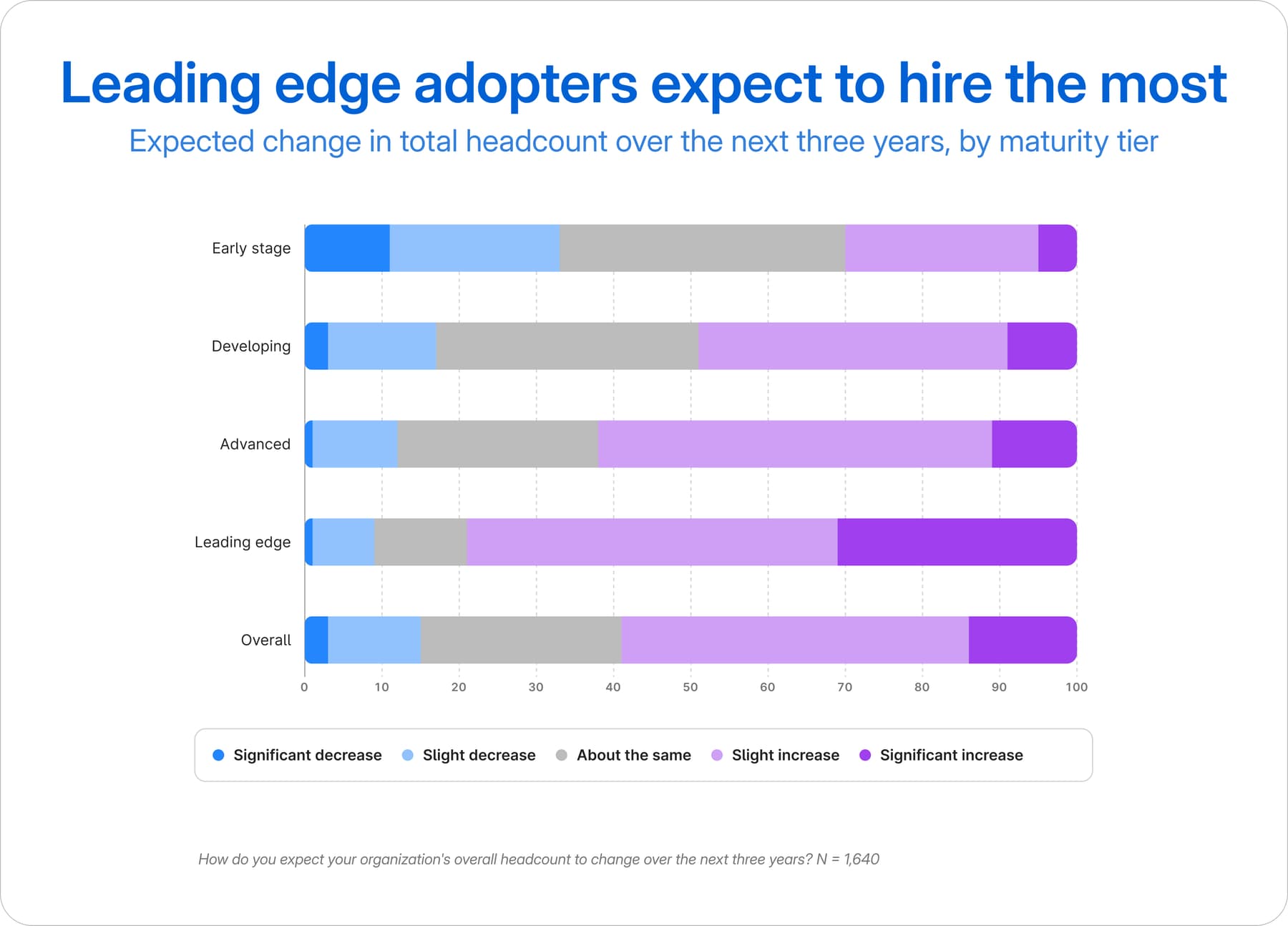
The headcount question shows one of the sharpest differences in response between leading-edge and early-stage in the whole report. 30% of early-stage organizations expect headcount to rise. 79% of leading edge ones do, with 31% expecting a significant increase.
Agents are reshaping team structures and roles
Nevertheless, ˮIs headcount going up?ˮ is too simple a question. The better one is ˮWhat does work look like in an agentic enterprise?ˮ
Asked how AI is reshaping work in their organization, only 12% of respondents expect limited impact on roles or team structures.
58% expect their organizationʼs total headcount to grow over the next three years.
Asked about their strategy, 22% of respondents say that they plan to augment individuals′ capabilities with agents, but make little change to team composition. 30% are pursuing significant role redesign with smaller human teams supported by AI. And 34% are pursuing a ′digital workforce strategy′. In this strategy, agents are formally onboarded with defined roles, owning parts of workflows previously owned by humans. Humans are involved only in oversight and exception- handling roles. Agents formally onboarded with defined roles, permissions, and performance management, owning parts of workflows people previously owned.
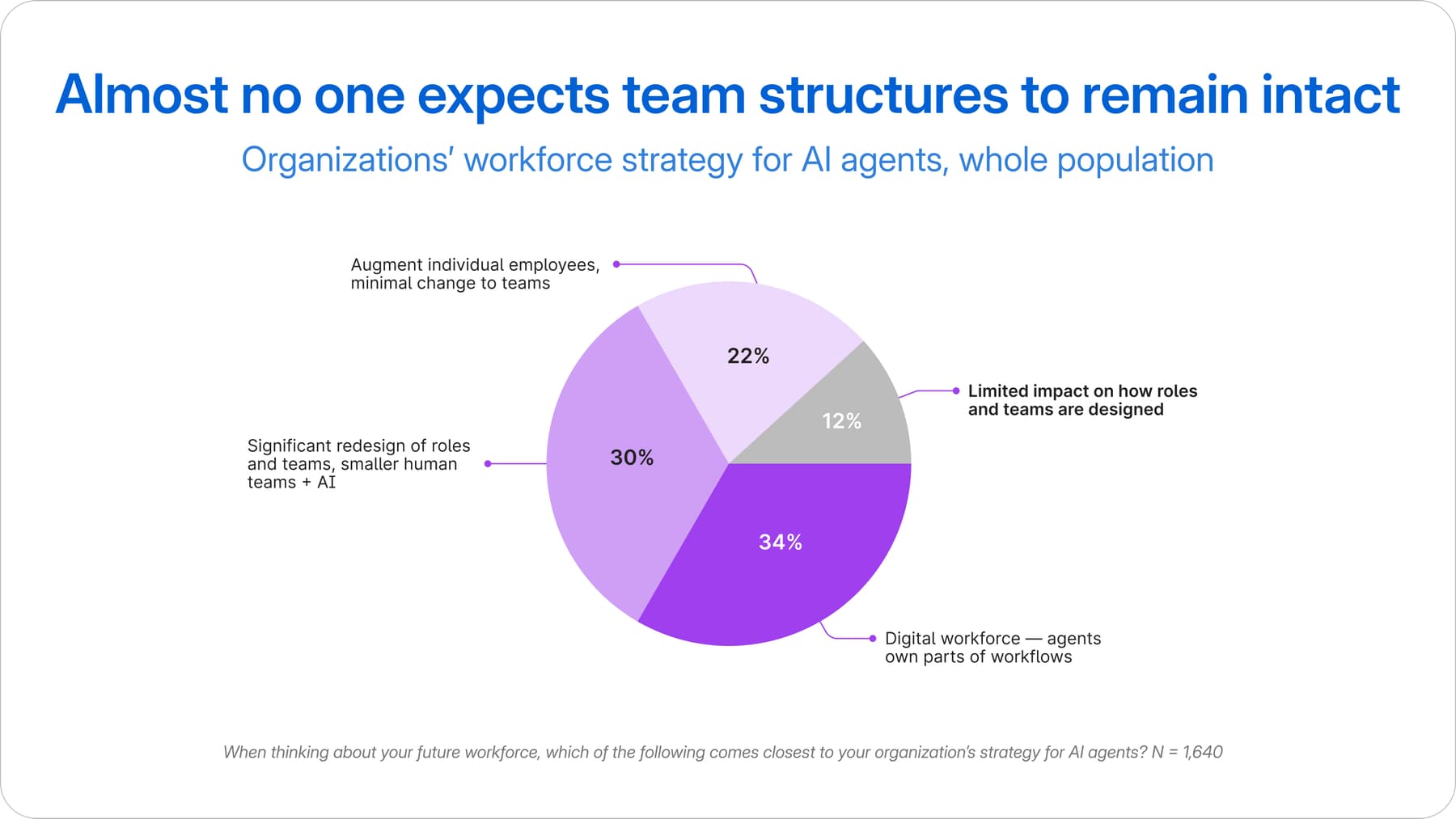
When asked how AI is reshaping work in their organization, only 12% of respondents expect limited impact on roles or team structures.
New roles are early evidence of growing demand
It may seem surprising that a clear majority of respondents expect headcount to rise in the next three years. But the mechanism underpinning that growth has held through every previous technology wave. As AI lowers the cost of the work an organization already does, demand for that work expands, and the workforce reshapes around this new capacity. The new role categories now forming on enterprise org charts are the first visible sign of that pattern in agentic AI.
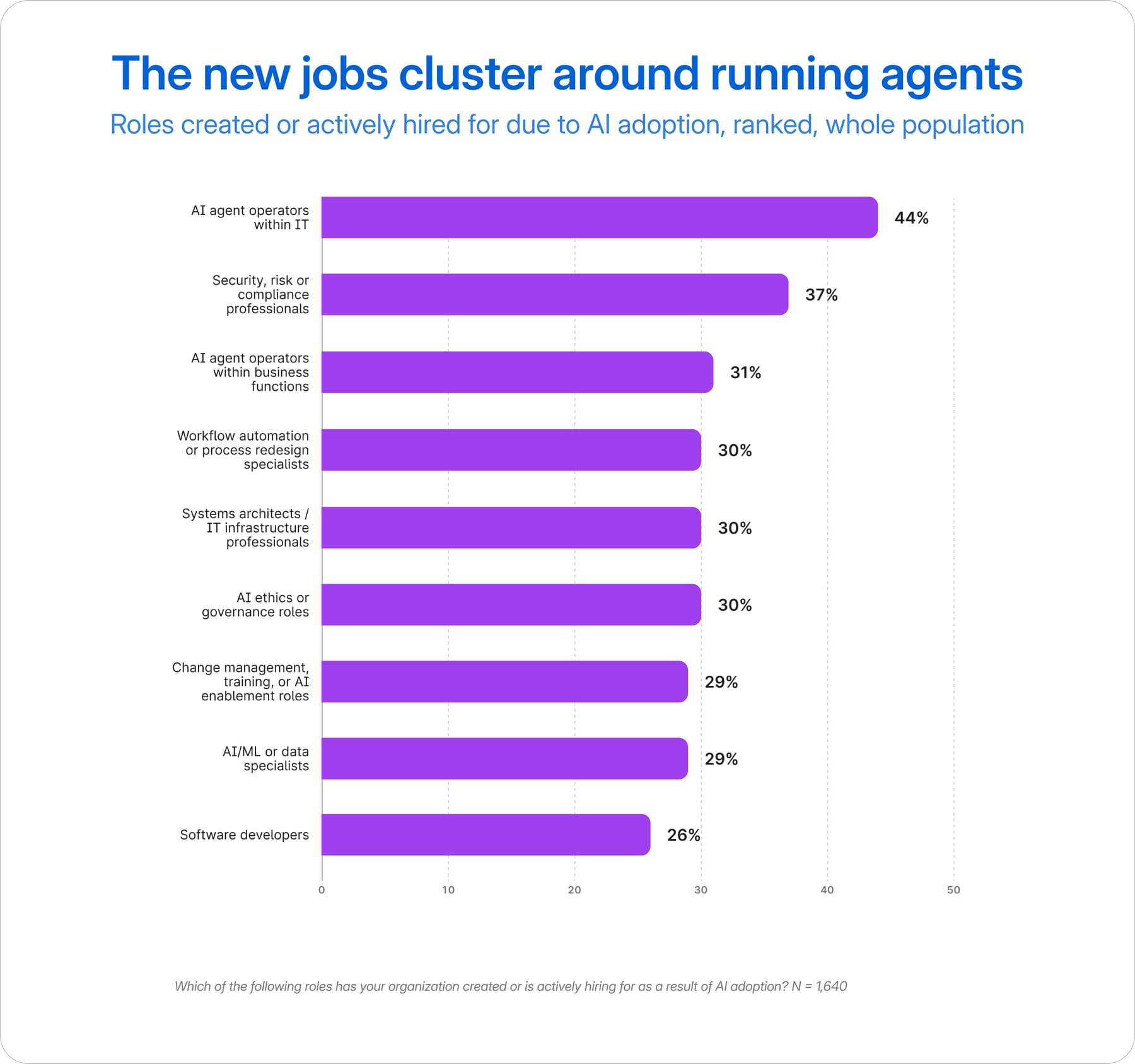
When asked about the new roles created as a result of AI adoption, the most common categories form a recognizable cluster. AI agent operators in IT — the people who configure, monitor, and maintain agents in production — lead, with 44% of respondents saying they are actively hiring here. AI-adjacent security, risk and compliance professionals follow at 37%. Agent operators inside business functions sit at 31%; workflow automation and process-redesign specialists, and AI ethics and governance roles each sit at 30%.
As much as agents bring to the table, human empathy really matters. You always need humans. The balance is letting AI do what AI does best, and letting humans bring the emotion to the table.
Three of these roles - agent operators in IT, agent operators in business functions, and workflow automation specialists — are variants of one emerging role: the forward-deployed (or AI automation) engineer, embedded in a business process to make sure agents work effectively inside it. Whether they sit on the customer′s payroll or arrive through a vendor or system integrator, FDEs do much the same work. Agents reshape workflows; workflows need domain-specific implementation, evaluation, and maintenance; and the people who do that work are becoming a permanent fixture of the enterprise AI economy.
There were a few hundred thousand people employed across marketing-related job categories in the 1970s in the US; today, it′s in the low millions. How did we experience a 5X+ increase in these jobs in 50 years at the exact same time that technology made this work far more efficient? Actually precisely because of those efficiencies.
This cluster is about AI implementation: adapting agents to specific business contexts, then running, governing, and auditing them. Only 4% of all organizations report not hiring for any AI-related role; at the leading edge, the figure is 0%.
Efficiency gains can expand demand, even as roles change
The personal computer was forecast to eliminate the secretarial workforce; white-collar employment rose. The web was forecast to eliminate the high street; retail employment moved rather than disappeared. Specific roles vanished each time: the typing pool, the travel agent, the corner bookshop. Aggregate employment climbed anyway.
The mechanism is Jevons’ Paradox: when a technology lowers the cost of a unit of work, demand for that work expands faster than efficiency rises, and employment in the affected domain grows even as cost per unit falls.
The workforce being built around the agentic enterprise will be larger, differently shaped, and concentrated around capabilities that didn’t exist on most org charts just a few years ago.
Frequently Asked Questions
Will AI reduce overall headcount in enterprises?
According to Box's 2026 State of AI in the Enterprise report, 58% of IT decision-makers expect their organization's total headcount to grow over the next three years. Only 9% say AI agents are primarily eliminating roles today.
How does AI adoption affect headcount expectations at leading-edge organizations?
The difference is significant: 79% of leading-edge organizations expect headcount to rise, compared to just 30% of early-stage organizations. Leading-edge adopters are the most optimistic, with 31% expecting a significant increase.
What new roles are enterprises hiring for as a result of AI adoption?
The most common new roles include AI agent operators in IT (44% of organizations are actively hiring), AI-adjacent security, risk, and compliance professionals (37%), agent operators inside business functions (31%), and workflow automation and process-redesign specialists (30%).
What is a forward-deployed engineer in the context of enterprise AI?
A forward-deployed engineer is embedded in a business process to configure, evaluate, and maintain AI agents so they work effectively within that context. Whether on a company's own payroll or through a vendor, these professionals are becoming a permanent fixture of the enterprise AI economy.
How are enterprises restructuring teams around AI agents?
Strategies vary: 22% plan to augment individuals with agents while keeping team structures largely intact, 30% are pursuing significant role redesign with smaller human teams supported by AI, and 34% are pursuing a digital workforce strategy where agents are formally onboarded with defined roles and humans focus on oversight and exception-handling.
Why does AI adoption tend to expand rather than shrink the workforce?
The article points to Jevons' Paradox: when technology lowers the cost of a unit of work, demand for that work expands faster than efficiency rises, growing overall employment even as cost per unit falls. This pattern has held through previous technology waves, from the personal computer to the web.
Are any organizations not hiring for AI-related roles at all?
Only 4% of all organizations report not hiring for any AI-related role. Among leading-edge organizations, that figure drops to 0%.
This is chapter 6 of Box's State of AI in the Enterprise report 2026. Read more:
1: Executive Summary | 2: The Maturity Gap | 3: Context | 4: Control | 5: Change | 6: Capability | 7: Conclusion
-----